Steam Era Ends As No.6306 Chuffs Out OF NYC Yards
No 6306 steamed out of the yards of the New York Central Railroad into the dusk the other evening, and it marked the twilight close of a colorful era in railroading — the era of the steam locomotive.
The diesels have taken over in the New York Central yards at Van Wert even down to the yard shifter engine, leaving nothing but nostalgic memories of the chug chugging steam engine with its stack belching smoke.
Old No. 6306 was built in 1918 about the close of World War I. It was the H-6 type, with four 63-inch driving wheels on each side. It ran on the Northern District of the Ohio Division most of the time.
The engine had a traction power of 54,720 pounds, and was capable of pulling up to 65 loaded freight cars.
When the engine left the Van Wert yard it carried only the caboose and the train crew of five men, and was consigned to Sharonville, where it will probably be put to work on another division of the railroad.
F. R. McCleary, engine house foreman, had little to comment but stated that “if they were going to diesels, they might as well all be diesels.” This, he thought, would simplify the maintenance problems.
R. D. Gamble, a brakeman on the crew that piloted old 6306 on its final run, opined in a poem he composed for the occasion, that there would be “no more steam leaks to fix,” and “we’ll all miss the large smoke rings that were made chugging up,.the hill, and the whistle on cold nights that sounded so loud and shrill.”
W. R. Foster, trainmaster stated that the successors to the steam locomotives are two-unit diesel locomotives, which develop 3,000 horse power and are capable of hauling 65 per cent more tonnage on the road.
THE NOSTALGIA of the moment was caught by Gamble in his poem which, for composition reasons, is reproduced here in prose form:
Preston called my house and he had this to say, “The last steam engine on the C. N. will soon be on its way. Now, please tell Russ to come over and be sure he’s shaven clean; also that he’s called for his run to leave at five fifteen. He’s to come over to the round-house for some pictures they will take of the last steam engine on the C. N., her farewell trip to make.”
Mr. Foster the super was present, but he seemed kinda blue, as he started his career as a !railroad man on steam locomotives, too. Hi chief clerk, Mr. Reasoner, stood gazing at old sixty-three aught six; never again need he call a mechanic, no more steam leaks to fix.
Mr. Wampler, the track supervisor, he was also there—will be much better for him now to keep the tracks in repair.
Fireman Bebout was elated and stood there looking wise; his thoughts were about a shovel and. no more cinders in his eyes.
THEN TOO, there was brakeman Sutphen, who had not much to say, but the glint in his eyes showed he was happy; now he’d get diesels every day.
There proudly stood the engineer, whose full name is Fred White; he’ll handle the throttle her last trip over the C. N. all right.
Conductor Yocum stood erect and I heard him heave a sigh; the last trio with steam on the Northern and he’d forgot his tie.
Flagman R. D. Gamble stood in line and thinking away back when the Cincinnati Northern shops employed several hundred men.
The roundhouse foreman was also there and his name is McCleary, and by his side was his assistant and we all call him Sned Wherry.
We all formed a half circle and the photog commanded, “Smile;” us trying to keep the lump in our throat down that had been there all the while.
We’ll all miss the large smoke rings that were made chugging up the hill and the whistle on cold nights that sounded so loud and shrill.
But we know we cannot stop progress, it advances every day; so we must progress along in railroading— diesel power is here to stay.
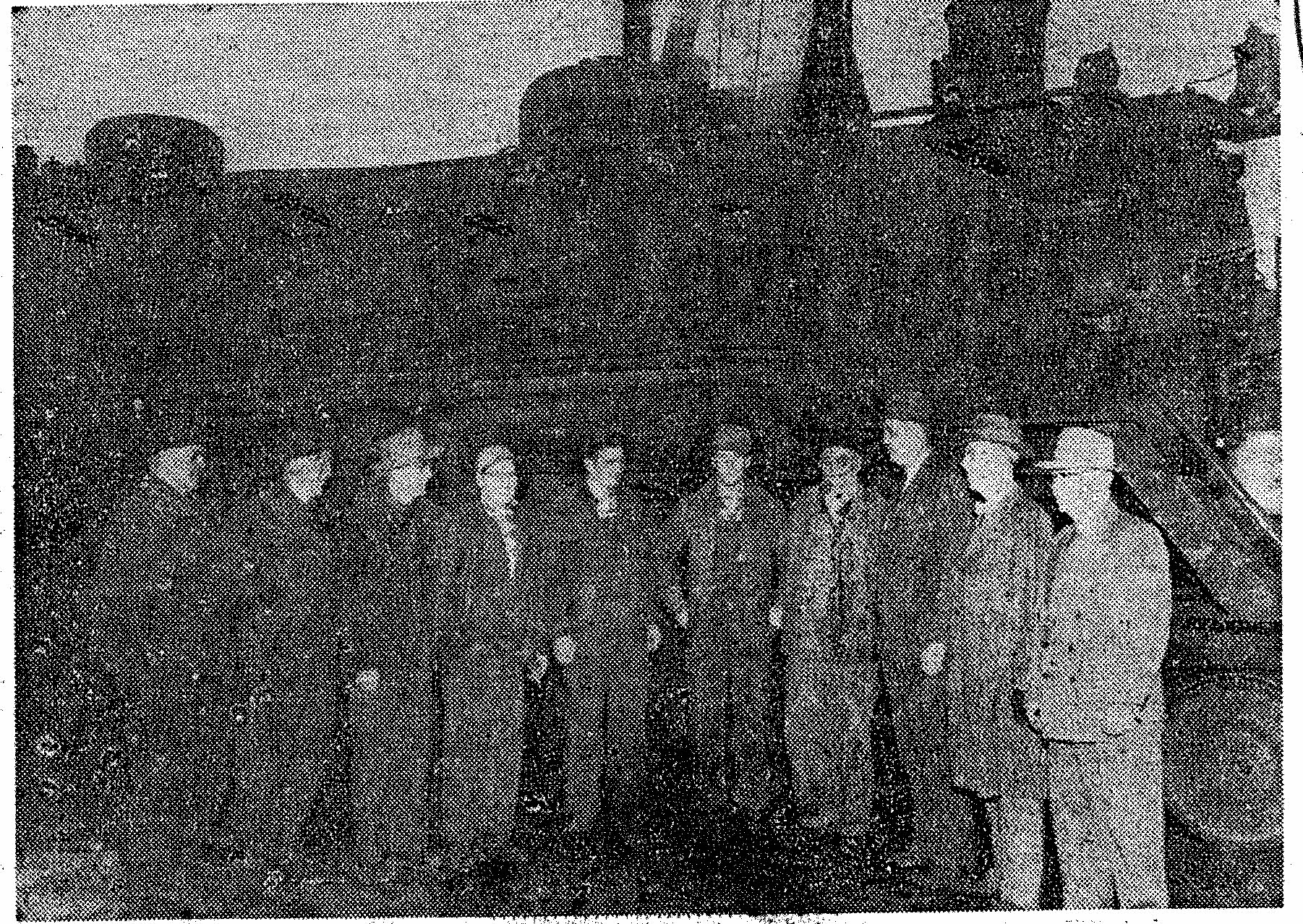
LAST STEAMER OUT. Crewmen, railroad officials, and maintenance men assembled in the Van Wert yard of the New York Central Railroad recently to see the start of the final run out of the city for steam locomotive No. 6306. The men pictured above are, from left: A. V. Wherry, hostler; F. R. McCleary, engine house foreman; R. D. Gamble, brakeman; G. W. Yocum, conductor; N. D. Sutphen, brakeman; H. H. Bebout; fireman; F. J. White; engineer; W. R. Foster, trainmaster; Russell Reasoner, chief clerk; and R. D. Wampler, track supervisor. (Staff Photo)